The Box Room Sound: Why One Cheap Mic Still Wins
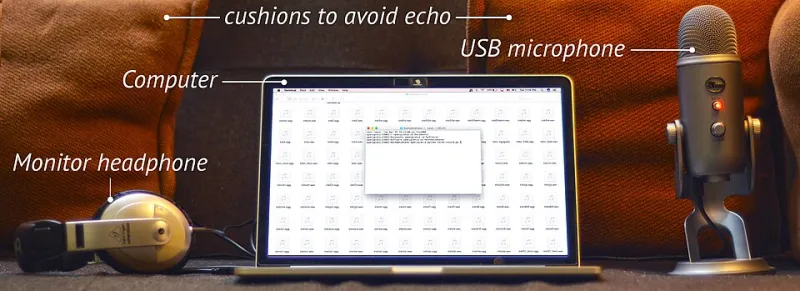
Photo: Subhashish Panigrahi, CC BY-SA 4.0, via Wikimedia Commons
My studio is a box room in a flat, and the entire recording setup cost about £200. I am not going to pretend that was a noble artistic choice. It was mostly a budget choice that hardened into a habit. But the habit has a sound. People recognise it before they recognise the songs.
The mic that should not be the sound
The main microphone is a second-hand dynamic mic bought from a bloke in Sheffield. It was designed for stages, not bedrooms. It does not capture air, it does not flatter vowels, and it makes my voice sound like it is being beamed in from a nearby corridor. I have tried fancy condensers. They made everything sound more expensive and less like me. The cheap mic has a bluntness I have come to rely on. It refuses to smooth over the fact that I am a person in a room.
The room is the co-producer
The room is roughly two and a half metres by three, with a low ceiling and a wardrobe that is doing more acoustic work than any foam panel I own. There is a duvet fortress behind me, a mattress propped against one wall and a window that rattles when the buses go past. It is not a good room. It is a specific room. I have learnt its resonances the way you learn a friend's moods. The low end piles up around 180Hz. The corner near the door makes everything sound cupped. The middle of the room is honest but dull. So I sing slightly off-centre, facing the wardrobe, with the mic close enough to catch the plosives and far enough to catch the fact that I am in a small space.
The £200 ledger
The breakdown is unglamorous: second-hand mic, cheap audio interface, a pair of headphones that clamp too hard, a stand, a cable and a duvet that was already on the bed. I did not buy monitors for years. I mixed on headphones and checked the results in the car, on a kitchen radio and through the tiny speaker on my phone. That is not a recommended workflow. It is, however, a very good way to learn what actually matters in a mix. If the song survives a phone speaker in a Newcastle kitchen, it will survive most things.
Workarounds that became rules
The limitations have produced a set of rules I now follow on purpose. One microphone means I commit to a vocal take rather than comping myself into a robot. Distance is my EQ: closer for intimacy, further for air. I record at night because the street is quieter and the room feels less self-conscious. I leave in small imperfections, like the chair squeak at the start of Kitchen Radio or the rain against the window on February. Those sounds are not mistakes to me any more. They are the room signing its name.
Happy accidents and UK weather
Home recording in the UK means you learn to work with weather. A radiator clicking, a neighbour's door, a delivery van reversing, all of it can end up on the track. I used to edit those sounds out. Now I ask whether they are doing any harm. Sometimes they are the only thing stopping a song from sounding like it was made in a laboratory. The hiss from the cheap interface is part of the texture. The slightly boxy vocal is part of the character. A cleaner recording would be a different record, and I am not sure it would be a better one.
Why I still have not upgraded
Every year I think about buying a better mic. Every year I do not. Some of that is stubbornness. Some of it is the fear that a new microphone would make my old recordings sound like demos. But mostly it is because the box room sound is now a reference point. When I write, I hear the room in my head. When I record, I am trying to get back to that small, close, slightly awkward feeling. Better gear would not automatically get me there. It would just give me more ways to avoid the take.
The contrarian bit
Here is the argument I would make to any UK songwriter eyeing a new preamp: gear obsession is often just fear with a shopping list. A better microphone will not write a better bridge. A treated room will not make you braver in the vocal booth. I am not saying equipment is irrelevant. I am saying that constraints can be collaborators if you stop treating them as obstacles. Spend a month with the gear you already own. Record ten takes. Listen to what the room is doing. Then decide whether you need to upgrade or just need to finish the song.
The £200 studio is not a humblebrag. It is a working method. It has taught me more about arrangement, performance and honesty than any piece of equipment I have ever borrowed. And if the sound is slightly boxy, slightly hissy and slightly wrong, that is because it is mine.